All resources

Free resource · Version 1.0

AI Experiment Canvas

A free framework for testing AI ideas before you bet on them.

Most AI pilots don’t stall because the technology fails. They stall because no one defined the problem, agreed what success looks like, or decided ahead of time when to stop. The Canvas takes you through nine sections in four phases—Frame, Design, Evaluate, and Decide—so every experiment ends with a decision, not a shrug.

Download the canvas

Same framework, two formats

Not sure which one? Start with the canvas. If you run out of room, or the team keeps debating a section, move to the workbook.

Fillable PDF · 488 KB

One-page Canvas

For smaller experiments and early alignment. Fill it in on screen or print it for a working session. Use it when you need the team on the same page in an hour, not a week.

  • Best for a 30–60 minute first pass
  • Fillable fields and checkboxes
  • Print-friendly US Letter landscape layout
Word workbook · 149 KB

Expanded Workbook

For experiments with real stakes: customer-facing tools, sensitive data, or a decision someone will have to defend. Each section gets its own page, and the response areas grow as you write.

  • 13 editable pages
  • Response areas expand as you type
  • Best for complex or collaborative experiments
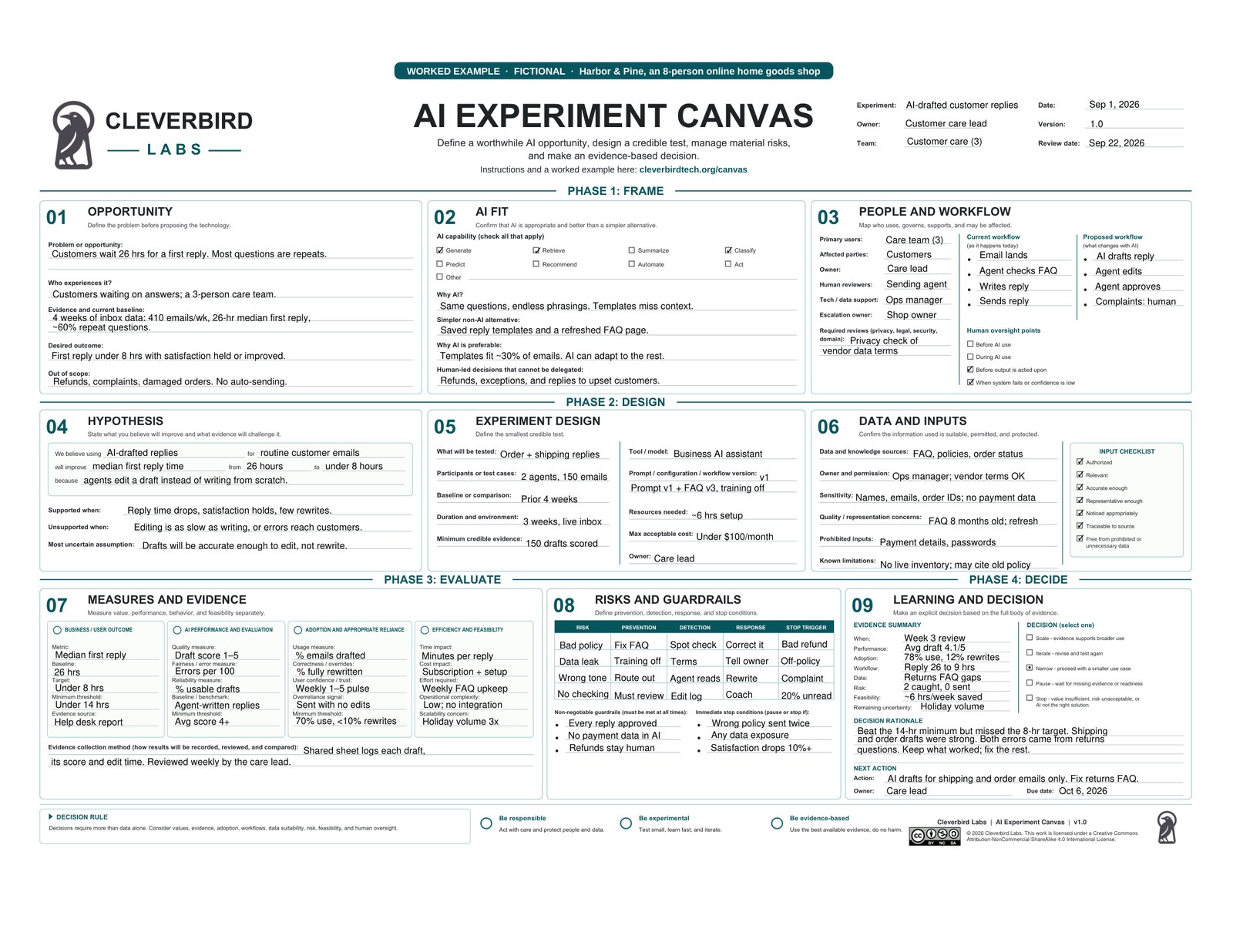
Filled AI Experiment Canvas for a fictional Harbor and Pine customer-email experiment
See a filled example (fictional)

Save a copy before entering information. For the PDF, use a viewer that supports fillable forms and save your progress as you work.

How to use it

Move from question to decision

Work through the sections in sequence. Set measures and stop conditions before testing, then make one explicit decision from the full body of evidence.

  1. 01

    Start with the problem

    Ask whether AI is the right answer at all. “No” is a useful result.

  2. 02

    Write the hypothesis

    State what you expect to happen—and what would prove you wrong—before you run anything.

  3. 03

    Measure separately

    Track user outcome, AI performance, adoption, and feasibility as distinct signals.

  4. 04

    Make the call

    Choose Scale, Iterate, Narrow, Pause, or Stop, then write down why.

Who it’s for

The same questions, whatever the size of the bet

The Canvas works for owner-operators testing their first AI idea and for teams inside larger organizations that need to build a credible case before they scale one.

Free to use and adapt for noncommercial purposes with attribution. Adaptations must use the same Creative Commons license.

Worked example · Fictional

Harbor & Pine customer-email experiment

An eight-person online home-goods shop tested AI-drafted replies to routine customer emails for three weeks. A person approved every reply before it was sent.

  1. 01

    Opportunity

    Routine replies took 26 hours on average and created a growing support backlog.

  2. 02

    AI fit

    AI could draft replies, but people retained every decision to approve, edit, or reject them.

  3. 03

    People and workflow

    Support staff reviewed drafts before customers received anything.

  4. 04

    Hypothesis

    Drafting assistance would reduce reply time from 26 hours toward an eight-hour target.

  5. 05

    Experiment design

    The team tested shipping, order, and returns questions for three weeks.

  6. 06

    Data and inputs

    Approved policies and FAQs grounded the drafts; unnecessary customer data was excluded.

  7. 07

    Measures and evidence

    The team tracked reply time, errors, human edits, and whether staff used the drafts.

  8. 08

    Risks and guardrails

    Every reply required review, and inaccurate policy guidance triggered correction or a pause.

  9. 09

    Learning and decision

    Reply time fell to nine hours. Shipping and order drafts were strong; returns caused both errors. Decision: narrow, fix the returns FAQ, and retest.

See the method in practice

Follow a completed experiment from question to decision.

Read Experiment 01